Showing posts with label misc. Show all posts

Saturday, August 04, 2012

Fields, Haslem, Payton to visit Taiwan for 3-on-3 event

tumblr_m875slNghq1qi117mo1_400

Former NBA great Gary Payton, Miami Heat forward Udonis Haslem and Toronto Raptors forward Landry Fields are scheduled to visit Taiwan for NBA 3X, a FIBA-sanctioned three-on-three event, from Aug 25-26.

A maximum of 408 teams are able to register for the event which would earn them ranking points in a global ranking system, according to Bros Sports, one of the local organizers, along with NBA Taiwan and the Chinese Taipei Basketball Association (CTBA).

Apart from the three-on-three competition, a slam dunk contest, a three-point shootout and a skill challenge would also be held.

Saturday, July 28, 2012

Taiwanese basketball pays tribute to late South Korean coach

SN03_010d128080

Taiwanese basketball circles were shocked at the news that Chung Kwon-suk, who led Taiwan NT to the fifth place in 2009 FIBA Asia Championship, passed away after battling kidney cancer.

Chung reportedly passed away at the age of 67 on Thursday in South Korea.

A South Korean legendary coach, Chung earned his reputation as the head coach who led South Korea to Asian title in the 1997 FIBA Asia Championship, its first Asian title since 1969, with a win over China and the first berth in the World Championship in 1998.

Tuesday, February 28, 2012

In search of the next Jeremy Lin

Joy Burke_1TJ Burke_2

Like other Asian countries, Taiwan has never stopped searching Taiwanese-born players or players with Taiwanese descent who were trained or are playing in the US to boost its basketball strength.

With the unexpected emergence and the global popularity of New York Knicks guard Jeremy Lin, it has been even more so.

The Central News Agency, Taiwan's semi-governmental new agency, has recently reported on a new case that the Chinese Taipei Basketball Association may want to take a look at.

The story reported on Joy Burke and TJ Burke, who hailed from Arizona and are playing at Arizona State and UC Riverside, respectively.

Monday, May 23, 2011

Former NT coach accused of extramarital affairs

6

Former Yulon Luxgen and Taiwan NT head coach Lee Yung-kwang was accused by his wife of having extramarital affairs, Taiwan media reported this past week, sending a shockwave through local basketball community.

According to media report, Lee's wife filed a lawsuit against Lee, who is now an associate professor at Taipei Physical Education College, for committing adultery with a 29-year-old girl.

Saturday, April 02, 2011

Confession

I'm sorry for not posting anything to the blog for almost the entire March. I visited New Zealand for 10 days for a business trip and the heavy work load had kept me from writing basketball regularly.

I begin to wonder whether I should stop posting those game stats, which took me a lot of time, because the SBL now (finally) has an efficient stats webpage where you can find anything if you can read Chinese.

The final decision has not been made yet. The most important thing is whether I will have enough time to keep writing the reports I have been writing for more than 10 years. However, I do think that there should be someone writing about Taiwanese basketball in English regularly so local basketball can be understood and recognized by English-speaking fans.

As I write now Taiwan Beer and Dacin Tigers have booked their appearances in the 2011 SBL Finals. On paper, TB is too strong to lose in a best-of-seven series, given that it features almost half of the national team lineup.

However, I have made it a habit not to support teams which only improve themselves by accumulating top players. My love goes to teams like Butler or VCU, lesser known teams or underdogs. That said, I hope Dacin can pull off an upset to make local basketball much more excited.

Friday, October 22, 2010

Out of town notice and 2010 Probation Cup

I will be out of town for a trip for five days, during which the 2010 Probation Cup (Guanhu Cup) invitational tournament will be played in the eastern Taiwan city of Hualien. So I will not update this blog until Oct. 28.

Four SBL teams -- Yulon, Taiwan Beer, Dacin and Bank of Taiwan -- and a pair of Chinese teams - Liaoning and Sichuan -- entered the six-team tournament.

The tournament has been plagued by bad weather in Taiwan as Typhoon Megi has brought around one meter of rain in eastern Taiwan over the past 24 hours.

In the first day of action Thursday, Liaoning, a team in the first division Chinese Basketball Association, pounded BOT 85-52. BOT was led by Chuan Hsiao-wen's 13 points and Sun Huan-po's 10 points.

Yulon Luxgen defeated Sichuan of the Chinese second division NBL 72-64 with Chou Shih-yuan pacing the team with 18 points and Lin Kuan-lun added 14. Sichuan won the NBL regular season champion with a 16-2 record this past season. However, it only finished 5th in the post-season.

Sunday, October 03, 2010

Weekly tidbits: Nancy Liu, SLAM and Taiwan Beer

-- An interview with Nancy Liu
Recently I had an opportunity to interview a special girl who is so hopelessly in love with basketball that she quit her job earier this year and spent 63 days in eight European countries to watch 25 pro teams play in 50 games, including the Eurocups Finals and the Euroleague Final Four because of her passion for the game of basketball.

Her name is Nancy Liu, a Taiwanese girl whose name is probably sort of well-known in some European basketball circles by now. Liu also stayed in Turkey to witness the entire 2010 World Championship and has been featured in a FIBA television interview.

Well, check out the video clip for yourself here and make sure to read her blog at http://abasketballdream.blogspot.com/

Yeah, a crazy girl indeed, but every passion starts with a crazy idea, doesn't it? I also happened to find out that Nancy is not only a huge Duke fan and a Virgo but also has been following my blog for a while, which is why I have to write this post for her. Haha.

Read my interview below.

Taiwanese basketball junkie lives her dream in Europe
Nancy Liu has often woken up during the past six months not knowing where she was. All she knew was she was somewhere in Europe -- and that's exactly how she wanted it.

Liu is an uncommonly dedicated sports fan, even by basketball junkie standards. She quit her job and visited 33 European cities in in 63 days from March to May this year to watch professional basketball games in person.

"I love the swishing sound of a basketball going through the net. And I'm uncomfortable if I don't play basketball for two or three days, " said Liu, who started playing basketball in fifth grade when she attended an international school in Beijing, China.

Already familiar with the American basketball scene, including the professional National Basketball Association (NBA) and the college game, Liu said her passion for the sport took her to the other side of the Atlantic to explore an area she was less familiar with the game played.

Liu quit her job at an international trading company and started to map out her plan to visit as many European teams and leagues as possible.

Helped by the many friends she made while volunteering at various local sporting events, including the Jones Cup basketball tournament, the Kaohsiung World Games and the Taipei Deaflympics, Liu set up about 70 percent of her itinerary before departing on what she called, "A Basketball Dream -- Ballin' Europe."

The basketball-loving girl, who majored in applied chemistry at Taiwan's National Chiao Tung University, began her basketball pilgrimage at a Swiss professional league game in Geneva less than 24 hours after arriving there.

In the following two months, the journey took Liu to numerous cities in eight countries -- Switzerland, Italy, Slovenia, France, Spain, Germany, the Netherlands and Greece.

In all, Liu attended 25 games and watched 50 teams play in various European domestic leagues as well as the Eurocup Finals and the Euroleague Final Four, both top-tier European basketball competitions.

Liu estimated that she slept an average of less than three hours a night during her stay in Europe and visited as many as three cities in one day.

After the two-month trip, she spent three months in Beijing to work as an intern at NBA China and returned to Taiwan for a day before resuming her travels.

This time she visited Turkey for the 2010 FIBA Men's World Championship and attended all of the tournament's games, while getting to see her favorite player -- Rudy Fernandez of Spain -- perform in person.

To save money during her European travels, Liu said she spent all but one night staying at friends' places, and ended up spending only around NT$200,000 (US$6,377) for the trip.

"Most of my budget was spent on transportation -- flight tickets, train tickets and bus fare, " Liu said. She also had to overcome "the unthinkable" in Europe, such as a French railway strike and the disruption of Euro air traffic by the eruption of a volcano in Iceland that left European skies bathed in inpenetrable ash.

Though basketball was at the center of her trip, Liu said it had even greater significance because she used every opportunity to let everyone know she's from Taiwan.

"This was my way of promoting Taiwan to the world, " she said.

Newspapers in Serbia and Greece gave extensive coverage to her ambitious trip, according to Liu. She was also interviewed by the International Basketball Federation (FIBA) during the World Championship.

Liu recalled that her parents expressed concerns about the trip when she first brought up the idea, but her father finally gave the go-ahead because "he didn't want me to miss the opportunity to realize my dream."

Her European trek has not brought her dream to an end. If anything it was only the beginning of loftier ambitions, including a return to Europe for the 2011 European Championship, which will be held in Lithuania next summer.

Liu's dream now extends beyond watching basketball games.

"I want to be involved in and initiate basketball-related nongovernment organization (NGO) projects which inspire children and the underprivileged through the sport, " said Liu, who described herself as being "broke" and is looking for a job to support her future plans.

"Basketball has been the inspiration to lift myself out of bed every morning since I was 13. I hope that the sport -- and my journey -- would be an inspiration for other people as well, " she said.

-- SLAM: Jeremy Lin
A while ago I also had a rare chance to be interviewed as a basketball writer by the SLAM magazine writer Ben Sin to talk about Jeremy Lin.

http://www.slamonline.com/online/nba/2010/09/defying-all-odds/

Whether or not Lin’s signing is driven by an agenda to boost ticket sales and buzz is up for debate, but the move has undoubtedly caused a positive reaction for the NBA in Taiwan. Chris Wang, a veteran sports journalist and current columnist for NBA.com in Taiwan, says Lin’s signing has increased interest in the League, although he isn’t sure if it’s increased enthusiasm for basketball in general, because Wang argues that, “pound for pound, Taiwanese basketball fans love of the game surpasses those in China.”

Lin and his family (parents and two brothers) appeared in an NBA-organized press conference in Taiwan less than 10 days after the signing. Hailed as “the first Taiwan player in the NBA,” Lin received a hero’s welcome at the press conference.

-- Taiwan Beer going to China?
There has been talks that Taiwan Beer is mulling to join the Chinese pro league CBA next year. The Chinese basketball authority has flat out rejected the report, saying that the 17-team league isn't planning for an expansion for now.

TB thought about joining the Chinese league for a couple of reasons. First of all, it figured that it would  benefit the team to be in the Chinese basketball market, which looks like a sponsor-rich and popular territory. Secondly, the relocation will be a part of the expansion plan of the Taiwan Beer Corporation, which has been trying to secure market access to China with warming Taiwan-China relations.

It was reported that TB Chairman Wei Po-tao had said he would spend 20-30 million RMB a year for the team to join the CBA, and the team is considering to make a city in Zhejiang Province as its homecourt.

Conflicting reports stated that TB might stay in Taiwan and choose Taipei as its home, but this is highly unlikely because it will cost Chinese teams a lot more on transportation if they have to play in Taiwan. On the political front, having Chinese teams play in Taiwan will definitely stir up controversy.

Anyway, I tend to look at it as just another rumor for now. It's possible that Taiwanese teams will join the CBA in the future, but not in another three years due to too many concerns and techinical difficulties, I think.

Thursday, August 05, 2010

Lee Chi-wei in Adidas Nation tourney

6-3 shooting guard Lee Chi-wei is on Team Asia in this week's Adidas Nation tournament.

Adidas Nations brings together the top 18 and under basketball players to compete in an international exhibition under the guidance of highly esteemed NBA veterans, coaches and players.  Individually selected teams from the US, Latin America, Africa, Europe and Asia will all compete in Chicago August 5th – 9th.

2010 Team Asia

# Player Pos. Height Country

1 Yang Jinmeng PG 6'2" China

2 Li Qingxiang PG 6'2" China

3 Zhou Qi C 7'0" China

4 Ge Zhaobao C 7'0" China

5 Xing Zhiqiang WF 6'6" China

6 Heng Yifeng WF 6'4" China

7 Wei Zhengxian SG 6'5 China

8 Si Yuheng SG 6'4" China

9 Hu Yihan SG 6'2" China

10 Liu Zhixuan WF 6'4" China

11 Steven Adams F 6'10" New Zealand

12 Lee Chi-Wei SG 6'3" Taiwan

Head Coach: Frank Johnson: 14 -year NBA veteran; Former Head Coach, Phoenix Suns
Assistant Coaches: Chris Rivers and Li Ren
NBA Mentor:  Robin Lopez (Phoenix Suns)

Tuesday, August 03, 2010

Good luck to Bob

Happinets_press_conference

The post in intended to wish my old friend Robert Pierce all the best. Bob was just named the head coach of the Akita Northern Happinets, an expansion team in Japan's pro league BJ League. He was introduced in a press conference held Aug. 2 along with the new strength and conditioning coach Masa Kawamura and five new players.

For Bob's coaching career in Japan, please see below:

Pierce named Akita's first coach
The Japan Times

Bob Pierce, the first coach in Shiga Lakestars history, has been appointed the expansion Akita Northern Happinets' first coach, the bj-league team announced on Friday.

Pierce, who turns 50 on Sunday, guided the Lakestars to the team's first playoff berth last season. The team made a 10-win improvement in 2009-10, going 29-23 and finishing fourth in the ultra-competitive Western Conference.

Pierce's well-rounded career has also include time as the sideline supervisor of the JBL's Hitachi Sunrockers and a stint as an assistant coach for the Japan men's national team. He has also served as an Asia-based scout for the Cleveland Cavaliers.

Pierce filled the final coaching vacancy in the rapidly changing bj-league, which begins its sixth season in October. All told, only five of the league's 16 teams now have head coaches who held the same position with their respective teams at the start of the 2009-10 season.

(Photo: Bob Pierce)

Thursday, July 29, 2010

Where SBL games are played

1205966926

Before a new stadium that can house more than 5,000 is built in downtown Taipei city, it looks like the SBL games will have to be played -- like they have in the past season -- at Sinjhuang Stadium in Sinjhuang City, Taipei County, located on the outskirt of Taipei.

Most people think that a downtown arena is desperately needed to boost SBL attendance and, at the same time, make it convenient for fans to go to the games.

Anyway, before that happens, anyone interested in watching SBL games live will have to visit this venue -- Sinjhuang Stadium.

See below the screen shots of the Google Maps. The stadium is located in a sports park, which also has a baseball park, a outdoor stadium for track and field events and outdoor tennis courts.

sinjhuang-1

satellite-1


For direction and transportation information, please visit this link. The contents are all in mandarin but I don’t have time to translate them.

Tuesday, January 05, 2010

Taiwan's sports marketing

An article from Taiwan government-sponsored magazine Taiwan Review:


Health and Happiness for Sale
Byline:JIM HWANG
Publication Date:01/01/2010

9121511441171

The Indiana Pacers played the Denver Nuggets in an exhibition match at the Taipei Arena in October 2009, marking the first NBA game ever played in Taiwan. (Central News Agency)

Taiwan’s sports marketers are building upon the success of a recent NBA exhibition game as they promote events and products.

Surveys from the Sports Affairs Council (SAC) show that basketball is the most popular participant ball sport played in Taiwan. Attending basketball games as a fan, however, is another story. Except for the season-ending championship series, for example, most people on the island think twice when asked to pay between NT$150 and $500 (US$4.50 and $15) to watch a regular season game of Taiwan’s semi-professional Super Basketball League (SBL).

And there does not seem to be much “discrimination” between local versus foreign events. When 10 top streetball players from the United States including Phillip “Hot Sauce” Champion and Grayson “The Professor” Boucher visited Taiwan for two exhibition games last September, for example, only 500 fans were willing to pay between NT$1,000 and $2,500 (US$30 and $75) for the first game at a 10,000-seat stadium in Linkou, Taipei County. The second game, originally scheduled to be played in Kaohsiung, southern Taiwan on the following day, was canceled. The marketing company that organized the event told the press that something had obviously gone wrong with their marketing strategy, and adjustments would have to be made if it was to bring another streetball game to Taiwan in the future.

Pleasant Surprise
So Eric Chang, general manager of Bros Sports Marketing, was pleasantly surprised when he learned that people were not hesitating to spend between NT$800 and $12,800 (US$24 to $387) for a ticket to the first-ever National Basketball Association (NBA) game played in Taiwan last October. According to Chang, the organizer of the event, except for the 3,000 tickets reserved for the NBA office and sponsors, all 9,000 tickets available to the public were sold out 15 minutes after online sales opened three months before the game. The eight VIP seats available for the game—which cost NT$200,000 (US$6,060) each and were not available via online sales—also sold out.

The two NBA teams, the Indiana Pacers and the Denver Nuggets, landed in Taipei on October 6. After their open practices on the following day and as part of the NBA Cares program, the players held a coaching session for 82 children sponsored by World Vision who were affected by Typhoon Morakot, which struck southern Taiwan last August. Then in the evening of October 8, about 12,000 fans filled the Taipei Arena to enjoy the power, speed and skills the teams demonstrated in the preseason game, as well as the passes, dunks and three-pointers of star players like Danny Granger of the Pacers and Carmelo Anthony and Chauncey Billups of the Nuggets. Based on the enthusiasm for the event, which was reflected by the high demand for tickets, Chang is confident about bringing in more professional matches—such as the Harlem Globetrotters or even a Major League Baseball game, for example—to Taiwan in the future.

Initially a vendor selling sporting goods and an organizer of sports-related recreation activities at the Hsinchu Science Park, Bros Sports Marketing was founded in 2001 and went on to become one of Taiwan’s first sports marketing firms, mostly because of the founders’ passion toward sports. Over the years, it has grown to become Taiwan’s largest company in the sector, and has helped organize many major sporting events such as 2009’s Kaohsiung World Games and Taipei Deaflympics.

Event-Marketing Approach
Shao Yu-lin, an associate professor of recreation and sports management at the Taipei Physical Education College, thinks that the Chinese Basketball Alliance (CBA), which was Taiwan’s only true professional basketball league before it folded in 1999 after five seasons, and the Chinese Professional Baseball League (CPBL), Taiwan’s professional baseball league, have both been instrumental in the institutionalization of sports marketing in Taiwan, although the CPBL has faced a series of scandals over the years. A professional team’s income is derived from ticket revenues, team merchandise sales, television revenues and advertising sales. Taiwan’s professional teams are all corporate owned. While these enterprises have many ways to market themselves, they usually take the most basic “event-marketing” approach, meaning the use of a single event or an activity to achieve a marketing objective or gain exposure for their teams. Whenever the Uni-President Lions win a season title or the annual championship, for example, all the 7-Elevens in the country, which are operated in Taiwan by Uni-President Corp., offer some kind of sale or discount for several days. These sales are not infrequent, as the Lions have won the Taiwan Series seven times since the league was founded in 1990.

201001p38

Taiwan Beer takes on the Yulon Dinos in a 2009 semi-final game in the SBL, Taiwan’s semi-professional basketball league. Despite the SBL’s talented players, energetic dancers and core of enthusiastic fans, ticket sales surge only during the playoffs. (Central News Agency)

Although by late last year some of the team’s players were being investigated for fixing matches during the 2009 season, the Brother Elephants, which in the 2003 season became the first CPBL team to turn a profit, has been the most successful team in marketing in terms of developing ad sponsorships. Rather than just placing sponsors’ logos on uniforms and advertisements around the field, the team “quantifies” these ads with reports on details such as exposure time and estimated value. “Sponsors like to see actual figures and the Brother Elephants team provides them,” Shao says. “While other teams go out to look for sponsors, enterprises have approached the Brother Elephants to run their advertisements.”

The La New Bears team is another successful example, although some former La New players were also facing match-fixing allegations in late 2009. Before buying a CPBL team in 2004, footwear manufacturer La New had already been using event marketing for its products by holding annual national health walk activities since 2000. When the company took control of the Bears, it  adopted Kaohsiung’s Cheng-Ching Lake Baseball Stadium and then took a more professional tack in managing the team, working to improve the diet, uniforms, living arrangements and transportation provided to the players. Such actions not only made a strong impression on the players themselves but garnered media attention, which served as free publicity to boost La New’s corporate image.

Shao estimates that the total number of “customers” for the CPBL is about 300,000 people, which is rather small compared to professional sports in other countries. While sports marketing capitalizes on the popularity of sports, it is very difficult for teams to be profitable in a small market like Taiwan. Most of the time, therefore, most teams are operated because the owners have a passion for baseball, rather than an overriding need to turn a profit. And it is most unfortunate that whenever the CPBL is about to turn profitable, a match-fixing scandal seems to bring it down to the bottom. Over the league’s past 20 seasons, there have been five such scandals.

But even with the CPBL’s ups and downs, more local enterprises have begun to warm up to the concept of marketing their products or brand names through sports, seeing it as a means of gaining an edge over their competitors. Giant Bicycles, for example, started sponsoring Spain’s ONCE team in the Tour de France in 2002. Repeated strong performances by the team have improved Giant’s image and helped it break into the high-end bicycle market in European countries.

Top personal computer manufacturer Acer Inc. is another Taiwanese company that has seen good results from marketing through sports. Acer signed New York Yankees pitcher Wang Chien-ming  as a spokesperson for its products in 2005. The “alignment” between the two, as Acer put it when signing Wang, was that both were Taiwanese “products” that, after years of struggle and hard work, earned their “brand names” internationally. It has been reported that when Wang has pitched well, sales of Acer products he endorses have experienced double-digit growth.

Collective Passion
From the point of view of marketing through sports, having an “alignment” with a star like Wang is helpful, but not required. “Sport is one thing that is capable of arousing collective passion,” says Eric Chang of Bros Sports Marketing. “Long-term sponsorship of sports events can usually make fans unconsciously associate a sport or a team with a brand name, however unrelated the two might seem to be.” As such, enterprises have also begun to view sponsoring sports as part of a longer-term plan instead of a one-off initiative. After watching women’s 9-ball billiards games, which have been popular in Taiwan for about a decade, for example, people are likely to think of the brand name Amway, which has been sponsoring the Amway WPA Women’s 9-Ball tournament since 1998. And when watching people jog, ING Antai Life Insurance (now Fubon Life) may come to mind, as the company has sponsored the ING Taipei International Marathon—an event that has drawn more than 100,000 local and international participants every year—since 2004.

Hsu Yang, an associate professor at Aletheia University’s Department of Sport Management, points out that sports marketing is a relatively new field even in the West. Most companies in the sector in Western countries were set up after 1990, while most were established in Taiwan after 2000. Although foreign sports marketing companies usually provide a full range of services in the areas of consulting, merchandising, client management and sports business investment, Taiwan’s companies focus mainly on hosting sporting events and seeking sponsorship. Hsu, however, does not think this difference is a problem. “The purpose of sports marketing is to sell sports products—goods, tickets or sponsorship,” he says. “Creative and good management of events create a good platform for selling these products.”

Organizing events, as Eric Chang sees it, is full of challenges in Taiwan. Preparing for the NBA’s Taipei game, for example, took Chang and his company 10 months of hard work that ranged from applying to the NBA office to host the game and finding sponsors to developing a series of marketing initiatives, including placing posters in cafes and convenience stores, fan activities, online games, downloadable NBA screen savers made available through popular local websites and even ads sent through cellphone text messages.

When planning such a major sporting event, securing financing is usually the first thing a planner has to deal with. The pay, transportation, accommodations and insurance for the NBA players and team staff for the Taipei game totaled US$8 million, of which US$1.8 million came from Chang’s company and the rest from sponsors including Cathay Financial Holding and Chunghwa Telecom. Money alone, however, is not enough to put on such a large event. “You need to have the heart to make it happen,” Chang says. “I’m a fan myself and have always wanted to watch an NBA game played in Taiwan, so it was like making a dream come true.”

Another difficulty for the local industry is a lack of professional experience in the field. Most employees at Bros Sports Marketing, for example, are sports enthusiasts like Chang, but initially had little familiarity with marketing. To help them gain the necessary knowledge, Chang offers his employees many marketing-related and language courses, as well as opportunities to observe how it is done in other countries. The company’s biggest prize at its year-end party, for example, can be flights and tickets to an NBA game.

There are no lack of departments and graduate programs devoted to sports marketing, sports and leisure studies, and sports management at local colleges and universities. The number of Taiwanese going to the United States to study sports marketing has also been increasing. “The problem is that students can’t really design efficient strategies for organization, marketing and human resource management without practical working experiences,” says Hsu Yang. “Meanwhile, college graduates often find it difficult to apply the fragmentary knowledge they’ve learned at school on the job.”

To offer his students some practical experience, Hsu has organized an annual project since 2006, in which sports marketing students are grouped and tasked with promoting sports in Danshui Township, Taipei County, where Aletheia University is located. The project lasts for nine months, spanning two semesters, and the students are required to design, manage and promote events that are able to attract fans and the notice of the media. One of the more successful events, according to Hsu, was a girl’s rugby game that drew about 700 audience members and 30 journalists to the match, with the event covered by Taiwan’s biggest television news channels.

Drawing such attention and media coverage to a non-mainstream sport can be viewed as an accomplishment in the field of sports marketing. A look at the ratio of the number of audience members at the game to the township’s overall population of 200,000, however, reflects the larger challenges of operating in a small market that the industry as a whole has been facing. In other words, just as the Aletheia students had to work hard to attract a small subgroup of women’s rugby fans from Danshui’s small total population, sports marketers for larger events face an uphill climb to attract a sufficient number of local sports fans from Taiwan’s relatively small total population of 23 million.

Like the efforts of nearly all governments around the world to improve physical fitness and quality of life by encouraging their people to make exercise a part of everyday life, Taiwan has also been promoting “sports for all” since the early 2000s by holding and funding sporting events. According to the SAC, about 20 percent of the people on the island now exercise habitually, though the number is still low compared to the 30 or even 40 percent in Western countries.

Although Chang does not offer what he considers a more accurate estimate, he thinks that the SAC’s number is way too high, but that is exactly why he is upbeat about the sports market in Taiwan. “It’s like selling footwear in Africa,” Chang says. “The fact that most people don’t wear shoes, or exercise regularly in our case, represents a huge potential market to be cultivated.” While selling shoes in Africa may be overly optimistic, marketing sports sounds doable in a developed economy where people have the time and money for the pursuit of health and happiness—of sports, that is.

http://taiwanreview.nat.gov.tw/ct.asp?ctNode=1446&xItem=83086&mp=1

Friday, January 01, 2010

Another Jeremy Lin feature from TIME.com

jeremy_lin_1211

Harvard's Hoops Star is Asian. Got a Problem with That?
By Sean Gregory

Certain truths are tied to March Madness, that time of year when the NCAA men's basketball tournament turns every cubicle-dweller into a college hoops junkie. That batty lady who picks the winners based on the cuteness of the mascots will crush you in your office pool. Duke will have a guy that gets under your skin. And the Harvard basketball players will be locked in the library instead pulling off the Cinderella upset.

It's been 64 years since the Crimson appeared in the NCAA tournament. But thanks to senior guard Jeremy Lin, that streak could end this year. Lin, who tops Harvard in points (18.1 per game), rebounds (5.3), assists (4.5) and steals (2.7), has led the team to a 9-3 record, its best start in a quarter century. Lin, a 6 '3" slasher whose speed, leaping ability, and passing skills would allow him to suit up for any team in the country, has saved his best performances for the toughest opponents: over his last four games against teams from the Big East and Atlantic Coast Conference, two of the country's most powerful basketball leagues, Lin is averaging 24.3 points and shooting nearly 65% from the field. "He's as good an all-around guard as I've seen," says Tony Shaver, the head coach of William & Mary, which in November lost a triple overtime game to Harvard, 87-85, after Lin hit a running three-pointer at the buzzer. "He's a special player who seems to have a special passion for the game. I wouldn't be surprised to see him in the NBA one day."

A Harvard hoopster with pro-level talent? Yes, that's one reason Lin is a novelty. But let's face it: Lin's ethnicity might be a bigger surprise. Less than 0.5% of men's Division 1 basketball players are Asian-American. Sure, the occasional giant from China, like Yao Ming, has played in the NBA. But in the U.S., basketball stars are African-Americans first, Caucasians second, and Asians. . . somewhere far down the line. (One historical footnote: Wat Misaka, who is Japanese American, became the first non-white person to play in the NBA in 1947.)

Lin caught the hoops bug from his father, Gie-Ming. Before he immigrated to the U.S. in the 1970s, Gie-Ming would scour Taiwanese television for any highlights of NBA games. Once in the states, he studied Larry Bird, Kareem Abdul-Jabbar and the classic Los Angeles Lakers-Boston Celtics games from the 1980s. "I cannot explain the reasons why I love basketball," says Gie-Ming, a computer engineer. "I just do."

By the time Jeremy was five, Gie-Ming was taking him to the local YMCA in Palo Atlo, California to play ball in a kid's league. For Jeremy, it wasn't exactly love at first sight. "He stood at half-court sucking his thumb for the eternity of about half his games that season," says Jeremy's older brother, Josh, 24. "It came to the point where my mom stopped going to watch his games." Then, Jeremy asked his mother, Shirley, to start coming to the Y again. Before Shirley would commit, however, she wanted to know if he'd actually try. "He responded with something along the lines of 'I'm going to play, and I'm going to score,'" Josh says. She showed up, and Jeremy scored the maximum amount of points one player could amass under the kiddy-league rules. "From that game on, he just took off and never looked back," says Josh.

Throughout Jeremy's childhood, Gie-Ming would take him to the YMCA after he finished his homework. They would practice, and play in pickup games. "Many Asian families focus so much on academics," says Gie-Ming. "But it felt so good to play with my kids, I enjoyed it so much." Jeremy won a state championship as a senior in high school, but he received no Division I scholarship offers (Ivy League schools cannot give athletic scholarships). Yes, he was scrawny, but don't doubt that a little racial profiling, intentionally or otherwise, contributed to his under-recruitment.

Some people still can't look past his ethnicity. Everywhere he plays, Lin is the target of cruel taunts. "It's everything you can imagine," he says. "Racial slurs, racial jokes, all having to do with being Asian." Even at the Ivy League gyms? "I've heard it at most of the Ivies, if not all of them," he says. Lin is reluctant to mention the specific nature of such insults, but according to Harvard teammate Oliver McNally, another Ivy League player called him a c-word that rhymes with "ink" during a game last season. Just last week, during Harvard's 86-70 loss to Georgetown in Washington, D.C., McNally says one spectator yelled "sweet and sour pork" from the stands.

In the face of such foolishness, Lin doesn't seem to lose it on the court. "Honestly, now, I don't react to it," he says. "I expect it, I'm used to it, it is what it is." Post-game, Lin will release some frustration. "He gets pissed about it afterwards," says McNally. "I have to tip my hat to him. I don't know how I'd react. The type of dude I am, I might not be as mature as Jeremy."

Lin's maturity could lead him to ministry. A devout Christian, Lin, who is an economics major, is considering becoming a pastor in a church near his Palo Alto home. "I've never really preached before," Lin says. "But I'm really passionate about Christianity and helping others. There's a beauty in seeing people change their lifestyles for the better."

Before settling on a career, however, Lin has some on-court business to attend to. Harvard has racked up some impressive wins early in the season. The team upset Boston College in early December, and knocked off a 9-2 George Washington team this week, 66-53. The Crimson, who play next at Seattle University on Jan. 2, should challenge two-time defending champion Cornell for the Ivy title; a league championship would give Harvard that elusive trip to the NCAA Tournament. And Lin wants to give pro basketball shot, most likely overseas or, who knows, maybe the NBA.

"I can definitely see him being in ministry," says Steve Chen, Lin's mentor and the pastor of the Mountain View, Calif. church the Lin family attends. "But right now, God has gifted him in a specific way, and he's going to go after it hard." If Lin leads Harvard to the tournament, he'd be off to a pretty holy start. Consider it his first miracle.

http://www.time.com/time/nation/article/0,8599,1951044,00.html

Saturday, December 12, 2009

ESPN feature on Taiwanese U.S. college player Jeremy Lin


Immigrant dream plays out through son
Harvard's do-it-all star learned the game from his father and a host of NBA legends

O'Neil By Dana O'Neil
ESPN.com

ncb_a_lin15_600 STORRS, Conn. -- The jump hook he used to score his first bucket of the game? That came from Kareem.

The perfect form on his jumper? Larry Bird deserves credit for that.

The power end-to-end drive with a dunk to finish? Vintage Dr. J.

The sweet dribble penetration and kickout? Score one for Magic.

As Jeremy Lin dissected and bisected Connecticut to the tune of 30 points Sunday afternoon, his father sat in front of a computer screen on the other side of the country, watching his videotape library of NBA greats come to life in the form of his son.

All those years Gie-Ming Lin spent rewinding his tapes so he could teach himself how to play a game he never even saw until he was an adult? All those hours spent in the local Y with his boys, schooling them in fundamentals over and over, building muscle memory without even knowing what the term meant? That silly dream, the one in which his children would fall in love with basketball as much as he had?

There it was, borne out in a gym in Storrs, Conn.

"Every time he did something good, they'd play it over and over again," Gie-Ming said from his home in Palo Alto, Calif. "I kept watching, and they kept showing him."

Soon the rest of the college basketball world might be turning its collective eye toward Jeremy Lin. Think about what the senior has done just this week for Harvard, which is off to its best start (7-2) in 25 years.

In keeping his team in the game right to the end, Lin scored a career-high 30 points and grabbed 9 boards in a 79-73 loss to No. 12 UConn. Then, in the Crimson's 74-67 upset at Boston College on Wednesday -- the second straight season Harvard has beaten BC -- Lin contributed 25 points.

ncb_i_lin12_400 So in two games against New England's annual NCAA tournament participants, Lin scored 55 points and shot 64 percent from the field and 80 percent from the free throw line.

He boasts an all-around repertoire rarely on display. Last season Lin was the only player in the nation to rank among the top 10 players in his conference in points, rebounds, assists, steals, blocks, field goal percentage, free throw percentage and 3-point percentage.

This year? He is merely second in the Ivy League in scoring (18.6 points), 10th in rebounding (5.3), fifth in field goal percentage (51.6 percent), third in assists (4.6), second in steals (2.4), sixth in blocked shots (1.2) and top of the pile in turning the heads of esteemed basketball minds, including Hall of Famer Jim Calhoun.

"I've seen a lot of teams come through here, and he could play for any of them," the longtime UConn coach said of Lin. "He's got great, great composure on the court. He knows how to play."

And he learned how to play thanks to his father's determination.

Jeremy is not the product of some Marv Marinovich in high-tops, desperate to cultivate the perfect basketball player, but rather a 5-foot-6 immigrant who long ago fell in love with a game and realized that in that game, his own children could gain entry into mainstream America.

Gie-Ming Lin was born in Taiwan, where academics were stressed and athletics ignored. He caught an occasional glimpse of basketball and, for reasons he can't explain, was immediately smitten with the game.

He dreamed of coming to the United States for two reasons: to complete his Ph.D. and "to watch the NBA."

That happened in 1977 when Gie-Ming enrolled at Purdue University for his doctorate in computer engineering. He flipped on the television, and there it was: the NBA in all its late-1970s glory. Kareem, Moses and Dr. J, with Jordan, Bird and Magic waiting in the wings.

"My dad," Jeremy said, "is a complete basketball junkie."
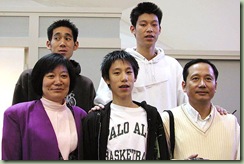
ncb_e_lin11_600 Gie-Ming's first job took him to Los Angeles, where the grueling demands and long hours had him searching for some sort of athletic release.

"I thought it would be great to play basketball," Gie-Ming said.

Only problem? He didn't have the slightest idea how. He had never picked up a ball in his life.

So he turned his attention back to those gripping NBA games. Armed with videotapes of his favorite players, Gie-Ming studied the game with the same fervor he studied for his Ph.D.

"I would just imitate them over and over; I got my hook shot from Kareem," Gie-Ming said, laughing.

It took him years to feel comfortable enough to play in a pickup game, and as he bided his time he decided then -- long before he even had children -- that his own kids would grow up knowing the game from an early age.

When first-born Joshua turned 5, Gie-Ming carted him to the local Y to begin teaching him those valuable skills stored on his videotapes.

Jeremy followed, and then youngest brother Joseph joined in what became a three-nights-a-week routine. The boys would finish their homework and around 8:30 head to the Y with their father for 90 minutes of drills or mini-games.

Forget that all of the players on those videos had long since retired, that the guy with Kareem's hook shot wouldn't hit Abdul-Jabbar's armpit. Gie-Ming recognized what so many other youth coaches have forgotten over time: The foundation for success is the basics.

"I realized if I brought them from a young age it would be like second nature for them," Gie-Ming said. "If they had the fundamentals, the rest would be easy."

ncb_a_lin14_400 His passion soon became their passion, and as the boys grew up, those 90-minute sessions would turn into wee-hour wars, with the boys scrounging for whatever gym they could find to play.

Joshua would star at Henry M. Gunn High School. Jeremy would enroll at rival Palo Alto High, where Joseph is now a senior.

Jeremy was special. He had his father's passion, his own inner motivation and a frame that would sprout to 6-foot-3. A good enough scorer to play 2-guard, Jeremy also was a savvy enough playmaker -- thanks to his dad and Magic -- to play the point. He's a solid outside shooter, but his dad, Julius and Kareem conspired to give him a reliable game around the rim.

In other words, he was otherworldly, a kid so talented that his freshman coach stood up at the team banquet and declared, "Jeremy has a better skill set than anyone I've ever seen at his age."

Named to the varsity as a freshman, Jeremy would earn honors as sophomore of the year and two-time most valuable player in his league.

Immersed in the game as he was, Jeremy never thought he was anything but a normal kid who liked basketball.

Until, that is, the insults came at him, the taunts to go back to China or open his eyes.

He was an Asian-American basketball player, an oddity and a curiosity in the cruel world of high school, where nothing is safer than being like everyone else.

"It was definitely a lot tougher for me growing up," he said. "There was just an overall lack of respect. People didn't think I could play."

His father offered sage advice.

"I told him people are going to say things to him, but he had to stay calm and not get excited by these words; they are only words," Gie-Ming said. "I told him to just win the game for your school and people will respect you."

Once more, Gie-Ming was right. In his senior season Jeremy averaged 15 points, 7 assists, 6 rebounds and 5 steals, leading Palo Alto to a 32-1 record and a stunning 51-47 victory over nationally ranked Mater Dei in the CIF Division II state championship game.

Along the way, he converted some of the people who had mocked him. When Palo Alto played Mater Dei, students from both Jeremy's high school and rival Henry M. Gunn High crowded a local pizza joint to cheer for Jeremy and his team.

Converting people outside Northern California was more difficult. By his senior season, Lin was the runaway choice for player of the year by virtually every California publication. Yet he didn't receive a single Division I scholarship offer.

Lin doesn't know why, but believes his ethnicity played a part.

Asian-Americans make up just 0.4 percent of Division I basketball rosters, according to the latest NCAA numbers. That equates to 20 players out of 5,051.

Harvard offered an education with a hefty price tag. (The Ivy League offers no athletic scholarships.) But it also offered the chance to play Division I ball. So Lin went without hesitation.

Four extremely successful years into his college career, he now finds himself packaged into an uncomfortable box. Lin is at once proud and frustrated with his place as the flag-bearer for Asian-American basketball players.

The Harvard uniform, the Asian background, it all still makes Jeremy something of a novelty. What he longs for most of all is to be a basketball player.

Not an Asian-American basketball player, just a basketball player.

"Jeremy has been one of the better players in the country for a while now," said Harvard coach Tommy Amaker, who, as a Duke graduate and former head coach at both Seton Hall and Michigan, knows a thing or two about talent. "He's as consistent as anyone in the game. People who haven't seen him are wowed by what they see, but we aren't. What you see is who he is."

But stereotypes die hard and remain propagated by the ignorant. At UConn, as Jeremy stepped to the free throw line for the first time, one disgraceful student chanted, "Won-ton soup."

"I do get tired of it; I just want to play," Lin said. "But I've also come to accept it and embrace it. If I help other kids, than it's worth it."

In their 109-year history, the Crimson have never won an Ivy League title and have managed only three second-place finishes. They have had just one league player of the year -- Joe Carrabino in 1984.

The last Harvard man to suit up in the NBA? Ed Smith in 1953.

Lin could change all of that, a thought that boggles the mind of the man who fell in love with a sport so many years ago.

"All this time he was growing up, I never thought about Jeremy playing in college or professionally," Gie-Ming said. "I just enjoyed watching him play. I'm just so proud of him and so happy for him. I told him my dream already has come true."

Dana O'Neil covers college basketball for ESPN.com and can be reached at espnoneil@live.com

http://sports.espn.go.com/ncb/columns/story?columnist=oneil_dana&id=4730385

Monday, September 28, 2009

Japanese, Taiwanese hoops situations similar

logo BJLogoJpeg

A good friend of mine sent me this Japan Times article. It's a good story which explains the situation Japanese basketball is in currently.

In fact, the situation over there is pretty much similar to what it is in Taiwan. Most of all, incompetent basketball associations…Read on…

====

Source says JBL teams in trouble, league not viable in long term
By ED ODEVEN

Japanese basketball is suffering from an identity crisis. Besides Yuta Tabuse, the average citizen cannot name a handful of other top-level Japanese players. Indeed, this is problem No. 1.

Making matters worse, the Japan Basketball Association, the sport's national governing body, remains woefully incompetent when it comes to assembling a men's national team that can seriously challenge for a spot in the Summer Olympics, having last qualified for the 1976 Montreal Games. This is another Grand Canyon-size issue.

In other words, the sport is irrelevant to most people in Japan.

Now, there is preliminary talk of a future merger between the Japan Basketball League and the upstart bj-league, which began play in the fall of 2005. (A JBA officials meeting will be held next weekend in Niigata.)

With the unwavering support of the JBA's public relations hype machine, the JBL likes to identify itself as the sport's performance and financial blueprint of success in Japan — the nation's true premier league. In reality, though, it's an act eerily similar to a magician's use of smoke and mirrors to complete a trick.

It's an illusion.

"If the bj-league actually agreed to (the merger), it would kill the bj-league, and eventually it would kill any of the bj-league teams that joined," a source told me. "The JBL (business) model, company-sponsored teams that pay all the bills, isn't sustainable because everyone bleeds money."

The evidence vehemently supports that claim.

"Since I have been involved with Japan basketball here, here are some of the JBL teams that have folded: Sumitomo, NKK, Japan Energy, Daiwa, Mitsui Insurance, Denso, Aichi Kikai, Hitachi Osaka, Fukuoka, Bosch (Zexel) and Isuzu," the source, looking back on the past dozen years, told The Japan Times. He also cited Marubeni, a former JBL first-division team that moved down to the second division and then folded.

Furthermore, Kumagai Gumi folded after the 1993-94 season, the OSG Phoenix left the JBL and became the bj-league's Hamamatsu Higashimikawa Phoenix after the 2007-08 season, and the teams now called the Saitama Broncos and Niigata Albirex BB defected from the JBL's ranks to help establish the bj-league in 2005.

"To improve basketball in Japan, the JBA and the JBL gave us the 'Super League,' which was just the same JBL, minus teams that folded, with a 'super' new name," the source continued. "Then they announced they would form a 'new' league. They even produced a farewell to the JBL, thanks for the memories. And the following season Japan was blessed with a brand new basketball league called the JBL. Not only the exact same league and the exact same teams, they couldn't even come up with a new name!"

During this year's NBA Summer League in Las Vegas, a discussion of Japanese basketball's current state of affairs came up among coaches.

The source said one JBL head coach expressed his hope that the two leagues would merge in the near future, "or else he feared that the JBL might fold."

"I don't know if he would make that same comment today, but the reality is that other than maybe Toyota and Aisin, all of the JBL teams could fold if they keep losing money."

Rera Kamuy Hokkaido has slashed its budget by about 33 percent for this season and is a team that "could go out of business at any time," he said. What's more, Hitachi's foreign player salaries have been reduced by about 40 percent this season, and Link Tochigi Brex's foreign player salaries are down by 30 to 40 percent, according to the source.

Again: The numbers show the reality that the JBL faces major obstacles in the future.

That's not to say, however, that the bj-league is thriving.

Take the Takamatsu Five Arrows, for example, who on Friday announced they are still ¥55 million short of their estimated necessary budget for this season.

The bj-league "has no major sponsors and no national team players," the source said, pinpointing two major problems for the bj-league, the second of which has been due to the fact that the JBA hasn't sanctioned the bj-league since its inception.

"Money problems have forced many teams to reduce salaries and budgets," he continued. "Oita, Takamatsu and Tokyo have been question marks all summer, although it looks like all three may field some kind of team this season . . . but we have to wait and see. And still there are three teams (Akita, Miyazaki, Shimane) waiting to join next season because of the low cost to get started and the fact that having a team in a small local market does attract support from fans and businesses."

* * * * *

Company-run sports teams are a relic of Japan's post-World War II economic boom. As society changed, illustrated by the Japan Football Association's 100-year plan for the J. League, the model switched to teams being supported and operated by business groups in a local area, rather than by a single corporation.

Which is why many believe the JBL's business model is outdated and its future existence is a question mark.

Another source, with key contacts in the bj-league and the JBL, dished out the following insight about JBL squads:

• Link Tochigi Brex "eyed (joining) the bj-league in the past. . . . The bj-league also shopped for Tabuse in the past, too."

• Toshiba "is hurting financially. Nakano-san (bj-league president/COO Hidemitsu Nakano) won't rest until Kanagawa gets a team. Maybe (the bj-league) will ask for the rights to manage the Brave Thunders since Toshiba refuses to run the team as a pro (team)."

• Hitachi is "ailing like Toshiba."

• Mitsubishi Electric probably won't defect to the bj-league, "but it won't surprise me since the team has been working to earn revenue and not depend on its corporate budget for the last three years. I have spoken to inside people and their ultimate goal is to be fully pro and gain favor by not being excessive baggage for the company."

* * * * *

During this global financial recession, all sports leagues have been affected by economic difficulties, including the NBA. The Miami Heat's basketball operations staff members, for example, took 20 percent pay cuts for the coming season so the team could avoid laying off more employees, ESPN.com recently reported.

Head coach Erik Spoelstra and team president Pat Riley are among those with reduced salaries in the aftermath of the team's May layoffs (20 members of the team's business operations staff).

The above facts are pertinent to the challenges now faced by the bj-league.

Or as this column's primary source pointed out: "If the bj-league stayed its present course, keeping costs down, expanding, but also getting rid of — or finding ways to strengthen — the weak franchises, and stopped worrying about someday pleasing the JBA, in about five years there would only be four to five JBL teams left, and eventually joining the bj-league would be the only option."

He added: "There are no bj-league teams that could really afford to operate as the JBL teams do, so any team that merged or joined the JBL would soon go out of business.

"Any compromise only works if you reduce the salaries for the players on JBL teams, disperse some or all of the JBL players throughout all of the teams, and have a draft to ensure that good college players don't all end up at Toyota or Aisin. I don't see any JBL teams agreeing to any of that anytime soon."

And so the status quo remains — at least for now.

Nevertheless, pro basketball's future in Japan remains cloudy.

"Most likely, there will be no agreement, compromise or merger," the source concluded. "And we will have to wait a few years to see who the survivors are."

Saturday, July 18, 2009

Follow Taiwan Hoops on Twitter

Umm…once again I have to clear things up. Since I have a day job, I will not be able to update the latest game results and recaps in time although I will be trying my very best to do so. And as you all know, the Jones Cup official website sucks. It neither provides live scoring and results update nor presents anything in English.

Which is why I set up a Twitter channel at http://twitter.com/taiwanhoops to update the latest game results as quick as possible. Welcome to follow Taiwan Hoops on Twitter. You can also read the latest tweets at the right column.

Sunday, June 21, 2009

Pacers, Nuggets to play NBA's first-ever game in Taipei

nba to taiwan

http://www.nba.com/2009/news/06/19/nba.taipei/index.html
Pacers, Nuggets to play NBA's first-ever game in Taipei

By Official release
Posted Jun 19 2009 11:53AM

TAIPEI, June 19, 2009 -- The National Basketball Association (NBA) today announced it will play its first-ever game in Taipei when the Denver Nuggets and Indiana Pacers tip off at the Taipei Arena on October 8, 2009. The announcement took place today in Taipei with NBA Greater China CEO Tim Chen, Mayor of Taipei Hau Lung-bin, Minister of the Sports Affairs Council Tai Hsia Ling, and President of Chinese Taipei Basketball Association Wang Ren-Da. Taipei will become the seventh Asian city to host an NBA game, following Beijing, Guangzhou, Macao, Shanghai, Tokyo and Yokohama.

NBA Taiwan Game-1 "October 8th will be an historic day for the NBA and for the millions of basketball fans in Taiwan," said NBA Greater China CEO Tim Chen. "Taiwan fans are very passionate about the game and we are honored to be able to present a matchup of these two great teams for them."

The game at the Taipei Arena, capacity 12,874, will showcase two talented teams and some of the NBA's best players. The Nuggets made it to the Western Conference finals this season and are led by two-time NBA All-Star Carmelo Anthony and the 2004 NBA Finals MVP Chauncey Billups. The Pacers are led by NBA All-Star Danny Granger who was the winner of the NBA's 2008-09 Most Improved Player award presented by Kia Motors and the fifth leading scorer in the league this season. The dance teams and mascots from both teams will be onsite to further provide an authentic NBA experience for fans.

As part of the league's commitment to social responsibility, NBA Cares will conduct community events in Taipei designed to positively impact the city and its youth. Since it began in 2005, NBA Cares has created 418 places where kids and families can live, learn or play in 20 countries across five continents.

"NBA fans in Taipei have been waiting a long time to see an NBA game in person and we are very excited to be hosting these two great teams in October," said Taipei Mayor, Mr. Hau Lung-bin. "Working together with the NBA, we plan to host an unforgettable event that will benefit our citizens and raise Taipei's profile as a premier destination for sporting events."

The game in Taipei is the fourth preseason game the NBA has announced that will be played outside the United States and Canada this October. NBA Europe Live presented by EA SPORTS will feature the Chicago Bulls and the Utah Jazz in London on Oct. 6 and the Jazz against the Euroleague's Real Madrid in Madrid on Oct. 8. NBA Mexico Game 2009 will feature the Phoenix Suns and the Philadelphia 76ers in Monterrey, Mexico on Oct. 18. To date, the NBA has staged a total of 93 games outside of the U.S. and Canada in 31 cities in 16 countries and territories.

The NBA, which opened its office in Taipei in 1997, continues to demonstrate its commitment to growing the game. During the 2008-09 season, three broadcast partners aired up to ten live games per week. In August 2008, former NBA Champions, Scottie Pippen, Clyde Drexler, Glen Rice and B.J. Armstrong teamed up with players from Taiwan's Super Basketball League to play two exhibition games as part of the NBA Legends Challenge. The league has organized dozens of other interactive fan events including NBA Madness, NBA Jam session and NBA 2-ball.

NBA Taiwan Game-2

NBA Taiwan Game-3

(Photos: Bros Sports Marketing)

Sunday, June 14, 2009

Kudos to my friend Bob Pierce

(Source: Japan Times)

Pierce looking to build on successful first season with Lakestars

By ED ODEVEN

Staff writer

The Japan Times will be featuring periodic interviews with individuals in the bj-league — Japan's first professional basketball circuit — which wrapped up its fourth season in May. Head coach Bob Pierce of the Shiga Lakestars is the subject of this week's profile. Pierce guided the team to a 19-33 record as a first-year expansion team.


1on1CoachBob Making a point: Shiga Lakestars coach Bob Pierce says his team gained valuable experience as an expansion team in the 2008-09 season. SHIGA LAKESTARS/BJ-LEAGUE

Age: 48

Hometown: Portland, Ore.

College: Biola University

Previous job: Cleveland Cavaliers scout (Asian region, 2005-07)

Fast facts: He has served as an assistant coach on the Japan national team and has been an assistant and head coach for the Hitachi Sunrockers of the JBL.

Looking back on the Lakestars' first season, what are your general thoughts on the team's performance? What went better than you expected? What didn't go as well as you'd hoped? And what happened basically the way you had thought it would?

During the regular season we beat every team at least once, so that was a sign that we could play and win against a variety of styles. But too often we played to the level of the competition.

We could play well and beat the best team (two wins against the Ryukyu Golden Kings), but kept losing to the worst team (five losses to Oita).

We didn't have a true go-to guy. Usually it was (forward) Ryan Rourke, but at times it was (center) Ray Schafer or (swingman) Bobby Nash. That often made winning close games much tougher.

I thought we had enough shooters, but we shot poorly from the 3-point line (30.1 percent) all season and from the free-throw line (62.5) as well.

And we need our Japanese players to score more. (Forward) Yosuke Machida had some good games, but never became the consistent scorer that we needed him to be.

So improving in those two areas will be a big key in the off season. But we had good team chemistry, great guys on and off the court, and I don't think I've ever enjoyed coaching a team as much.

Usually at the end of a long season there are some players you just can't stand anymore, but I looked forward to every practice, game and road trip with these guys.

Looking ahead to the upcoming draft and offseason moves, what do you feel are the team's biggest needs to address in terms of player personnel?

I think we need a power forward who is an elite rebounder, we need to add a really quick point guard, and then we need to find maybe one or two guys who are really good shooters/scorers as well as really good athletes.

Can you tell us what the team and individual players will be doing in the offseason to better prepare for the 2009-10 season? Will some of them compete for summer teams? If so, which teams?

I know Yosuke Machida and (point guard) Shinya Ogawa are going to spend a week in Hawaii, training and playing games at the University of Hawaii with Bobby Nash.

(Evessa) coach (Kensaku) Tennichi is inviting players to spend a week playing games in Osaka at the end of June, and we are encouraging all of our players to go if they are in Shiga at that time.

How would you rate the local coverage of the Lakestars on Shiga Prefecture TV stations, radio stations, Web sites, newspapers, etc.? What did you especially like and/or dislike in Year One coverage of the team?

I thought the coverage was pretty good. Eight to 10 of our Sunday home games were shown live on TV. The local TV station always showed game results and highlights on their broadcasts.

There were about four papers that would rotate and come in to interview me or players for stories about once a week.

I thought many of the individual features on players were really well done. But I disliked always being asked how I spent my private time or where I went in Shiga.

As a coach, how do you feel you changed by guiding a team in its inaugural year? Did it take a different approach than what you had faced in previous jobs?

The length of the season was the main challenge. There was the challenge of keeping enough things the same so that players would be relaxed, comfortable and confident in what they were doing.

But over the weeks and months I also had to keep presenting new drills, options on plays, etc. to keep things fresh and the players motivated.

Also, playing conference team eight times meant that we often needed different strategies to play the same team. I know we practiced five very different game plans to use against Rizing Fukuoka last season.

College coaches often say the best thing about freshman is they become sophomores. I'm glad we won't be the new guys next year. Not having a history, a record of success to fall back on or derive strength from, is hard on a new team.

Earlier in the season, you commented on your dislike of the one-and-one free-throw rule in the bj-league. What other rule(s) or game policy(ies) do you feel the league ought to consider changing?

I don't really have too many complaints about the rules. The one-and-one rule rewards the defense too much for fouling, so I would like to see that changed.

I do like that the 3-point line will be extended, but that will make practices tougher as no gyms we use will have the new 3-point line.

I wish the league would limit the number of foreign players per team to four (with the current on-the-court-three rule).

Teams with five imports have more fouls to give, so the games get rougher. My biggest complaint is that the league doesn't really monitor salaries, player signings, etc.

The Hamamatsu Higashimikawa Phoenix probably violated the league salary cap by a huge margin, but no one in the league seemed to know exactly what they were spending, all the extras and bonuses they were supposedly giving, etc. At least they couldn't buy a championship their first season.

What is your favorite basketball movie of all time? Why?

It's not the best basketball movie, that probably would be "Hoosiers," but my favorite is the 1977 movie "One on One" starring Robbie Benson.

1) I liked that it showed some of the cheating and corruption in college basketball.

2) It is a typical American underdog, fight-against-the-odds story.

3) My Dad took me to see it.

No one in my family was really into sports. I developed a love for basketball because of my neighbors and then because I went to basketball camp.

But my Dad knew I loved basketball, so he took me to see it, so that movie still has a very special meaning for me.

Has there been an article or book on basketball that has been quite influential in your development as a coach?

Dean Smith's "Basketball, Multiple Offense and Defense" taught me about the thought process, a systematic approach to try to cover all situations and to teach them clearly.

Every coach should own and read this book. I used his "freelance passing game" when I coached my first team of 9- and 10-year-olds. It's still one of the best ways to teach and learn the game.

I use very different offenses and defenses now, but still within the framework that Coach Smith set up.

"Foul" by David Wolff, the Connie Hawkins story. My favorite book of all time. I read it over and over. I just loved the whole world of basketball culture, good and bad.

And reading how Connie really grew and matured when he went overseas with the Globetrotters may be what steered me towards international basketball.

If you could add any player in the world to be LeBron James' right-hand man in Cleveland, his supplement superstar as Peter Vecsey has said, who would you pick? (Assume the role of GM in this case).

LeBron needs a big man who can run the pick-and-roll with him, pop out and hit shots, and also be a presence inside. I would love to see him with Tim Duncan or Chris Bosh.

Sadly that might happen in 2010 in New York, not in Cleveland.

Or he needs a versatile scorer on the opposite wing, someone like Kevin Durant, so whichever one you focus on, the other one beats you.

What occurrence in the bj-league over the past season was most stunning to you? Most impressive? Most predictable? (I'm thinking of games, statistics and individual or team efforts — examples of things that really caught your eye.)

When I talk to other coaches, they are all stunned that we couldn't beat Oita. I was rather stunned when Toyama had a fire sale and let Babacar (Camara) and (Rodney) Webb go.

Most impressive performance was Jeff Newton's 50-point game in the semifinals.

Unbelievable!

Most predictable?

That the Hamamatsu Phoenix would go over the salary cap and try to "buy" a championship.

Humboldt State wins 2009 Kainan International Basketball Invitational

ShowImg.ashx

(Kainan Univ. vs. Univ. of Tokyo, photo source: Kainan Univ.)

Humboldt State University (Cali.) beat Bonds University from Australia 102-94 and won the 2009 Kainan International Basketball Invitational.

National Taiwan Normal University (NTNU) beat University of Tokyo from Japan to win the third place.

Sunday, June 07, 2009

Chung Shou-nai to play in NAIA school

thumb.ashx Chung Shou-nai will enroll in San Diego Christian College, a NAIA school in Southern California, and become the third player in U.S. college ball currently, reported Roundballcity.com -- arguably the best local basketball forum in Taiwan.

He was recruited by Conrad Sun, who was hired as head basketball coach at SDCC in March. Sun briefly played for Taiwan NT back in the 80's.

Chung, a 19 years-old 194cm forward, obviously inherited the basketball gene of his father Chung Chi-mun, who coached in defunct pro league CBA and SBL (Videoland Hunters) before moving on as a businessman in China.

The elder Chung played for Taiwan national team before getting into coaching.

Chung Shou-nai was selected in the SBL Draft this year by Taiwan Mobile. However, according to SBL regulation, Chung is not allowed to play in the league before his senior year in college.

Before Chung, Jet Chang and Swing Chuang -- I don't know where those weird first name came from -- already got a taste at US college ball. Jet Chang is now a sophomore at BYU Hawaii, a NCAA Div-II school. Chuang is now playing for Fullerton College, a two-year junior college at California state system.

Coach_Sun

Conrad Sun.

215

Father and son. Chung Chi-mun (left) and Chung Shou-nai.

(Photos: SDCC, Taiwan Mobile official website, Liberty Times)

Sunday, April 26, 2009

Pippen in Taipei

Scottie Pippen visited Songshan High School for a instructional game Saturday. He is in Taipei to endorse the 2009 Deaflympics.

(Photo: 2009 Deaflympics Organizing Committie)